Introduction
In 2025, Vibe Coding has taken the world by storm, presenting a unique opportunity for ordinary people. Seconds are breaking down technical barriers, evolving AI programming from simple toy projects to production-grade commercial applications. Over 500,000 applications have emerged, creating value exceeding 5 billion, enabling individuals without coding knowledge to effectively replace entire teams.
The Rise of Vibe Coding
As the word of the year announced by Collins English Dictionary, Vibe Coding has grown rapidly.
- Capital Aspect: Cursor’s valuation approached $9.9 billion; Google acquired core members of Windsurf to launch Antigravity.
- Product Aspect: Internationally, there are players like Claude Code, v0, and Lovable, while in China, Trae (ByteDance), Qcoder (Alibaba), and Comate (Baidu) are competing.
- Model Aspect: Whether it’s Gemini 3 or GPT 5.2, the immediate reaction post-release has been consistent: let’s use the new model to test a website.
In just a few months, stunning demos have flooded social media, and Vibe Coding has democratized software development.
Your Ideas, Your Applications, No Code Required
The history of software engineering is fundamentally a history of increasing abstraction levels. From machine language to assembly, from C to Python, each generation of programming languages has attempted to bridge the gap between human thought and machine logic.
Traditional low-code platforms reduce syntax errors through graphical interfaces but still require users to possess a “programmer’s mindset”—understanding loops, variables, and database paradigms.
The introduction of the Vibe Coding concept breaks this limitation. It no longer requires users to understand logical structures but instead demands clear expression of intent or vibe. In this model, natural language becomes the new compiler.
Previously, one needed to learn programming languages, algorithms, and data structures; now, all that is required is an idea and the ability to express that idea to AI!
The Commercialization of Vibe Coding
However, upon examining the dazzling videos on social media, one cannot ignore an undeniable fact: the vast majority of so-called “masterpieces” remain in the demo stage. They might be a bouncing ball, a retro-style calculator, or a simple To-Do list. These demos prove the feasibility of “Vibe” but have yet to touch upon the essence of business: deliverability, maintainability, and profitability.
In software engineering standards, a production-grade application must possess:
- Persistent Storage: Ability to securely store user data long-term (database capability).
- State Management: Ability to handle user logins, session persistence, and multi-user concurrency.
- Service Integration: Ability to interact with the outside world (payments, maps, searches).
- High Availability: System stability under load.
Currently, many Vibe Coding products remain at the prototype level; they can quickly generate stunning front-end interfaces but lack backend logic support, making them essentially one-time showcases.
From Toy Projects to Production-Level Applications
This year, Ant Group made a significant investment in Lingguang, promoting “flash applications” as its main selling point, emphasizing speed. Through substantial resource investment, Lingguang allowed the public to experience the thrill of “zero-based application creation” for the first time.
Baidu’s Seconds, launched over a year earlier, has shifted its focus from “toy projects” to “production-grade application building.”
In the latest IDC report and industry analysis, Baidu Seconds is recognized as a challenger in the AI no-code field. Compared to internationally renowned Lovable, which may focus more on front-end visuals and logic, Seconds is taking a clearer, more robust “one-stop full-stack” approach.
IDC noted that Seconds excelled in two core dimensions: “platform capability” and “application quality.” Particularly high scores in “service integration” and “application complexity support” indicate that Seconds has moved beyond being a “toy generator” and has become an effective tool for enterprise digital transformation.
Real Business Opportunities
At the recently concluded Seconds 2025 Creator Conference, Seconds revealed impressive statistics. In just 8 months since launch, the Seconds platform has generated over 500,000 commercial applications.
- High Value: Daily new applications have surged over 150%, with half featuring backend capabilities.
- Comprehensive Coverage: Applications span over 200 scenarios, including education, business, content creation, and enterprise services.
- Real Economic Value: Cumulatively created economic and efficiency value exceeding 5 billion.
These 500,000 applications are not just entertainment code produced by Vibe; they are real products grounded in business logic.
The Technology and Ecosystem Behind Production-Grade Applications
Seconds is deemed a “production-grade” platform due to Baidu’s strong self-developed front-end and back-end capabilities and specialized model capabilities.
Seconds operates with a virtual development team composed of multiple AI agents. Many Vibe Coding tools immediately start working on user requirements, often resulting in a basic HTML page. However, Seconds takes a smarter approach by first producing a product requirements document.
Just like in a production environment, the first step is to conduct a requirements review rather than letting programmers jump straight into coding. Thus, all Seconds projects begin with a requirements document, addressing two issues:
- Areas users may not have considered when inputting prompts;
- Mistakes users might make while inputting prompts.
Seconds’ production-grade capability shines here. For example, if a user requests a Minesweeper mini-program with only a single sentence of requirements, this often mirrors the real-world situation product managers face.
Seconds expands this into detailed functional requirements:
- What are the core functionalities?
- What is the gameplay like?
- What is the design style?
- What is the operation mode?
With a clear task plan, the development process can align as closely as possible with user needs.
Integrated Capabilities
Seconds provides an integrated capability of code, plugins, and backend services. Users can simply input their requirements in a dialog box to automatically complete tasks like calling plugins and configuring backend services, making front-end and back-end development more convenient.
Self-developed technology and deep collaboration with agents ensure high performance and flexibility. Agents can automatically manage database generation, queries, and backend services, significantly lowering development barriers. This collaborative mechanism allows Seconds to “automatically manage database generation, queries, and backend services.”
For users, this means they do not need to understand SQL language or configure servers; everything is done automatically through dialogue. This is the core technological barrier that enables Seconds to significantly lower development thresholds.
A Rich Plugin Ecosystem
A closed system cannot create immense commercial value. Seconds addresses the “island effect” of applications through a rich plugin ecosystem:
- Exclusive Baidu Services: Seconds is pre-equipped with exclusive capabilities like Baidu Search and Baidu Maps, meaning user-developed applications can inherently possess “location awareness” and “full-network information retrieval” capabilities. For instance, a real estate application can directly call Baidu Maps to display nearby facilities.
- AI Tool Matrix: The platform integrates AI tools for image and video generation.
- Third-party and Custom Plugins: Users can invoke external capabilities using simple “@” commands, such as “@Keling”. This interaction method greatly reduces the cognitive cost of API integration. In traditional development, integrating a video generation API requires reading documentation, applying for keys, and debugging interfaces; whereas in Seconds, one simply inputs “@Keling, help me generate a video,” and the agent handles all authentication and parameter passing.
With these plugins, creating multimodal content products becomes effortless.
Industrial-Level Product Capabilities
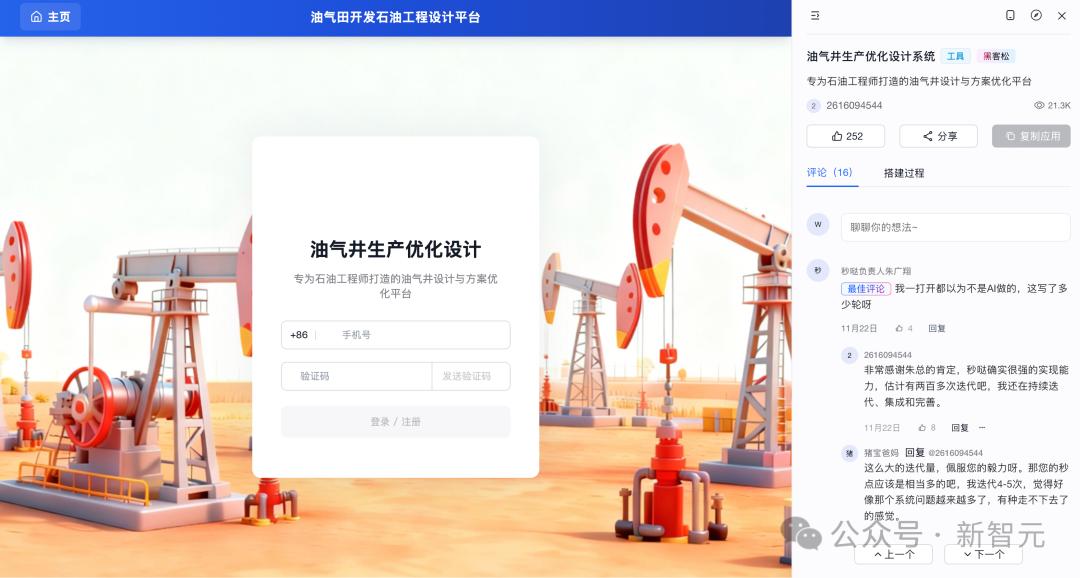
Some projects on Seconds are hard to believe were created by AI, given their completeness, professionalism, and product capabilities, which can be considered industrial-grade products. For example, an oil and gas well production optimization design system fooled even the Seconds head, Zhu Guangxiang.
Commercialization and Full-Chain Support
Development is just the first step; reaching users is key to commercialization. Seconds demonstrates strong ecological integration capabilities in its distribution mechanism, achieving “full-chain development and distribution integration.”
- WeChat Ecosystem Penetration: Seconds supports direct publishing of applications as WeChat mini-programs or native applications, breaking through traffic entry points.
- Search Engine Distribution: Leveraging Baidu’s search entry, quality applications have the opportunity to be displayed in search results, solving the cold start traffic issue.
Conclusion
The first batch of users utilizing Seconds are already making money. With over 500,000 commercial applications on the platform, serving millions, Seconds is at the forefront of commercialization. Applications mainly fall into three categories:
- E-commerce mini-programs and mini-games that serve as direct monetization tools, creating many “one-person companies”;
- Business software that helps frontline personnel build internal systems at low cost, reducing corporate reliance on R&D resources;
- AI efficiency applications that bring generative AI into learning, work, and life scenarios. These three types of applications have cumulatively created economic and efficiency value exceeding 5 billion.
Currently, over 20,000 applications have integrated payment capabilities, completing over 80,000 real transactions, accelerating AI applications towards scalable revenue generation. Many individuals who have never written or encountered code are now earning money using Seconds.
In the past, developing a customized enterprise management system (like ERP or CRM) required hiring a team of at least five people, including a product manager, UI designer, front-end, back-end, and tester, with development cycles lasting months and costs reaching millions. Through Seconds, users have completed similarly complex system constructions with just one person or a very small team, significantly reducing costs and minimizing trial-and-error expenses, allowing companies to respond quickly to market changes.
Seconds’ capabilities in “payments” and “user ecology” have enabled many creators to build paid tools or content services. For example, a product named “Snail Tooth” was created by a dental prevention education service provider using Seconds.
Reflecting on the past year, the product iteration path of Seconds has been clear: from initially creating simple applications to being able to produce “production-grade” applications on-site. This change reflects Baidu’s technical team’s pragmatic style, focusing on foundational infrastructure rather than merely the surface prosperity generated by LLMs.
Seconds is proving that AI is indeed changing the way humans work, breaking down the barriers of technical hierarchy. In the past, only those who understood code could enjoy the benefits of the software industry. Now, anyone with creativity and business acumen can become a creator.
Comments
Discussion is powered by Giscus (GitHub Discussions). Add
repo,repoID,category, andcategoryIDunder[params.comments.giscus]inhugo.tomlusing the values from the Giscus setup tool.